Earlier this year, President Donald Trump deployed the United States National Guard to Los Angeles, California, in response to anti-ICE protests in the city. While Trump used Section 12406 of Title 10 of the U.S. Code to support his decision, he still sparked significant controversy nationwide, prompting lawsuits and legal debates over whether he had the authority to do so. Since Los Angeles, the National Guard has been deployed to Washington, D.C.; Memphis, Tennessee; and briefly to Chicago, Illinois, in response to crime rates in these cities. Trump also attempted to deploy troops to Portland, Oregon, amid anti-ICE protests there, but was stopped by the courts.
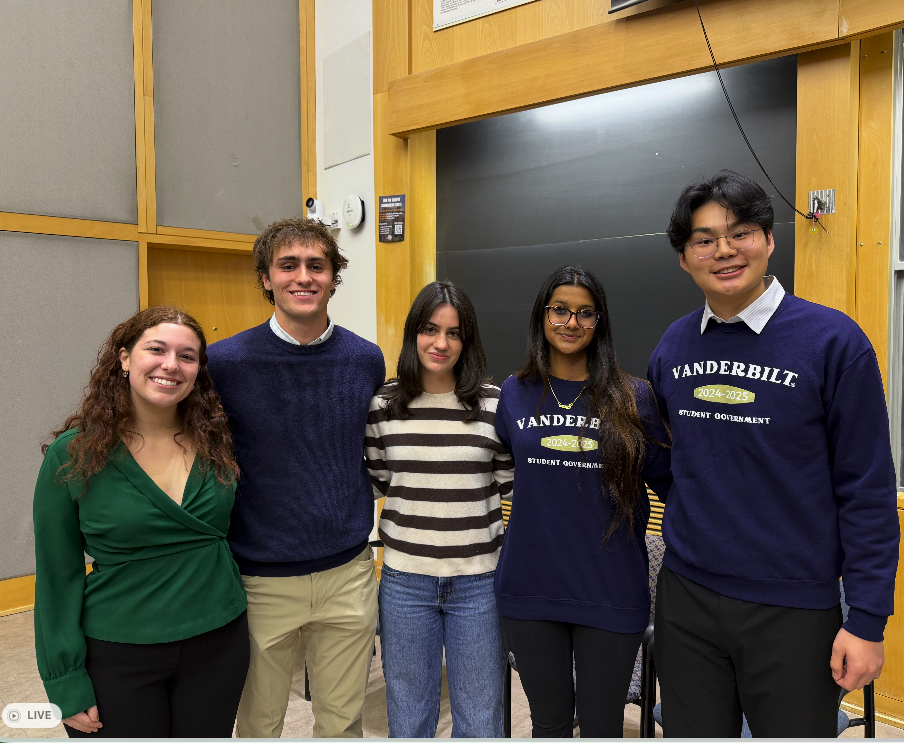
On September 30th, Vanderbilt Political Review (VPR) held an on-campus debate in Wilson Hall to allow students to share their thoughts on this issue. Participating in the debate were representatives from Vanderbilt College Democrats (VCD), Vanderbilt College Republicans (VCR), and Vanderbilt Political Review (VPR). VCD was represented by Elliot Cruz (‘28) and Emily Won (‘28). VCR was represented by Noah Jenkins (‘26) and Tristin O’Leary (‘28). VPR was represented by Saadika Salauddin (‘29) and Aaron Ferber (‘29). The debate was moderated by VPR Editor in Chief Alícia Isasi and lasted just over an hour.
“Is Trump’s use of the National Guard in Los Angeles, and threats to do so elsewhere, a legitimate use of executive authority?”
The debate opened with a question about executive authority. Won kicked off this conversation by stating that Trump’s deployment of the National Guard was already deemed unconstitutional, inviting VCR to respond. Jenkins countered by acknowledging the legality, or lack thereof, of the National Guard’s deployment, but claimed the court’s logic was faulty and had no legal precedent. Cruz responded that there was no legal precedent for this case because no president has taken these extreme measures before.
Jenkins then brought up the Posse Comitatus Act, which generally prohibits the use of the military for civilian policing unless “the President is unable with the regular forces to execute the laws of the United States; the President may call into Federal service members and units of the National Guard of any State in such numbers as he considers necessary to… execute those laws.”
Ferber said certain cases of Trump’s use of the National Guard were acceptable, such as in Louisiana, where the governor requested it. He emphasized the importance of respecting state cooperation in such instances. He added that in many of these cases, President Trump’s deployments appeared to focus on Democratic-leaning states, raising questions about political motivation.
“Regardless of presidential authority, should President Trump be able to activate the National Guard in a city without the state government’s consent?”
The next question revolved around federalism. Salauddin responded first, saying there should be an effort made to collaborate between the state and federal governments before resorting to the use of the National Guard, while also questioning the effects it has on these communities, such as small businesses receiving less customers and children being scared to go to school. Jenkins responded by saying there should be an initial attempt at collaboration, but “when those states of affairs fail, yes, it does go to the federal government to ensure that law and order are maintained in the country.”
Ferber then asked VCR if Trump’s heavy involvement in the states went against the Republican Party’s ideals of less federal involvement in local governments. VCR responded by saying it does not because, above all, it is the federal government’s responsibility to protect the law and order of our country when states fail to do so.
Won raised the question of what constitutes failure, and whether it undermines federalism if it is solely up to the President to decide when states have failed. Jenkins answered by saying that while federalism is the ideal situation, there are instances in which the localities do not handle the situation productively, and only in those cases will the federal government have to intervene.
“Who gets to decide the threshold for when the National Guard gets deployed? Should it be determined by data or by principle?“
Participants were then asked to define the threshold for National Guard deployment by an audience member. Ferber responded first, stating that data should always be the threshold for when the National Guard gets deployed. This was backed up by both Cruz and Salauddin, who argued that the ultimate threshold is the law, and that the President should always go through Congress before making these decisions.
Jenkins offered a counterargument to this, saying that “we live in an age where Congress doesn’t do much past passing budgets,” showing a potential efficiency problem by relying solely on Congress.
“Does the recent deployment of the National Guard by the President establish a dangerous precedent for the future?”
Lastly, the representatives were asked to consider future implications for the National Guard deployment. “We are opening the doors for authoritarian forms of government,” Salauddin stated, sharing her concerns with what the current administration’s actions could mean for the future. Won elaborated on this, bringing attention to the desensitization of civilians to the National Guard and the erosion of martial law ideals.
O’Leary countered by sharing his faith in the U.S. judicial system in determining when the president oversteps their authority. Jenkins supported this argument, adding that this is not the standard situation in the United States and that once the problem has been dealt with, the National Guard will return to their regular duties. He also added that a decrease in crime rates takes priority over citizens being uncomfortable with seeing the National Guard.
Won questioned whether the presence of the National Guard led to a decrease in crime rates, or if they were actively doing anything. Salauddin contributed to this point, saying if they were not improving the crime problem, then the National Guard was an “incredibly expensive patrol officer.”
Student Responses
At the end of the debate, Vanderbilt students filled out a survey sharing their opinions on the President’s authority to deploy the National Guard to U.S. cities. According to the survey, 68% of students shared they felt Trump’s use of the National Guard in Los Angeles, and threats to do so elsewhere, were not a legitimate use of executive authority, while 22% of students said it was. The remaining 10% were not sure. When asked if President Trump should be able to activate the National Guard without the state governor’s consent, regardless of presidential authority, the answers were less definite, with 56% answering no, 20% answering yes, and the remaining 24% saying it depends. Similar trends continued throughout the survey, with most students showing disapproval with President Trump’s actions and voting in favor of more congressional involvement.
Students also reflected on the debate itself, with several noting issues of redundancy and participation. One student commented that “it was a good debate, but I found the arguments and questions becoming repetitive,” while another added, “it’s frustrating listening to the same people talk for a long time, while also not answering the question at hand.”
Closing Thoughts and Implications of This Event
Following the debate, Salauddin shared her thoughts on the debate and the importance of events such as these on campus. She shared, “as a first-year student, it was such a great introduction to Vanderbilt’s political opportunities.” “In times like these, when open discourse can feel under fire, it means so much to see campus organizations creating spaces for thoughtful conversation.”
Her comments reflect a broader appreciation for open dialogue, a value that felt central to the event. The political atmosphere of this country seems to be more polarized every single day. It was encouraging to see today’s youth discuss political issues in an open and civilized manner. From the debate, it was also apparent that there is still some common ground between those with conflicting political beliefs, such as the need for a more solid, long-term solution to crime in cities. By hosting events like this, Vanderbilt continues, and will hopefully keep continuing, to foster an environment that encourages open discussion of complex topics, inspiring students to engage more deeply with the issues shaping our world.