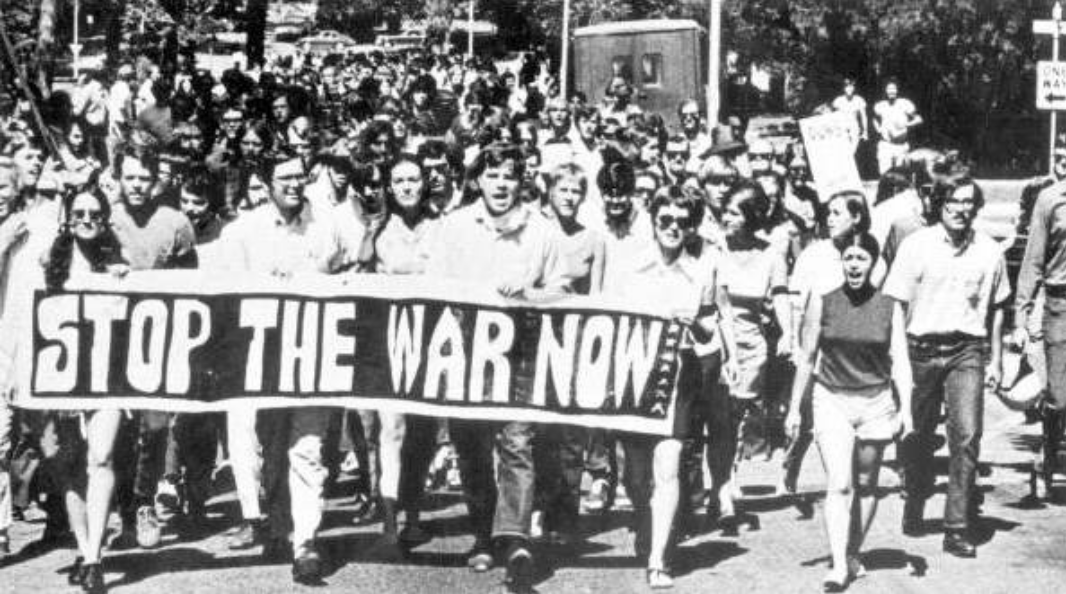
In the late 1960s and early 1970s, college campuses across the United States experienced overwhelming protests in response to the Vietnam War and President Richard Nixon’s handling of it. Throughout that time, well over one million students protested across over 1,000 campuses nationwide. At that time, almost 70% of college students favored holding back on the fighting in Vietnam. Those students understood the power of their First Amendment rights and decided to take full advantage.
Today, campus protests look vastly different. There is a lack of petitions, a lack of proposed legislation, and, in many ways, a lack of effort. A campus protest today seems to involve scheduled demonstrations where students hold up signs and chant. Not to mention the dwindling number of students who actually engage in campus protests. On the issue of the war between Israel and Hamas, as few as 16% of students were planning to participate in a protest regarding the war. Perhaps it is an absence of motivation that has caused the decline, or maybe it is due to campus policies. Whatever the reason may be, we cannot let our right to protest on college campuses slip away.
Looking back, the anti-war protests during the Nixon administration were important instruments of change, and not just because of the size of the protests. Of course, the baby boom from 1946 to 1964 helped, with college enrollment growing by seven million people between 1960 and 1970. However, it was the way in which those anti-war protests were conducted that enabled their success. Students quickly mobilized in response to Nixon’s plan to expand the war in Southeast Asia, and this mobilization became contagious, as seen with the millions of students who participated at hundreds of colleges. Those students were outraged by the war and channeled that anger into action. Not only was that action illustrated through the campus protests, but also through national coordination with the National Strike Information Center at Brandeis University. There, students sent out a daily newsletter about anti-war events and structured protests around the country. Thus, campus protests were both locally driven by students and connected to a network of strikes nationwide.
Although the political climate in 2026 may not mirror that of 1970, there is no less of a need for the youngest voters to voice their concerns and beliefs. Recently, the Department of Justice has been accused of withholding Epstein files while three U.S. service members have been killed in the conflict with Iran. These are issues worthy of protest, and protests have certainly occurred, but just not at college campuses. Many young Americans seem to find that protesting is somewhat of a hopeless process anymore. Still, this mindset creates a self-reinforcing cycle where college students do not want to protest because it does not create change, and then they do not create change because they have stopped protesting. If anything, today’s college students should look toward the past to find motivation and see the transformation that is possible through campus protests.
Some of the blame may also rest on the colleges themselves. Throughout the United States, universities are imposing restrictions on student protests, thereby discouraging students from protesting. For instance, several campuses have implemented limits on when protests or demonstrations can take place, like at Rutgers, where they can only happen from 9 a.m. to 4 p.m. This is a far cry from the occupations that lasted days if not weeks in May 1970. When colleges dictate how and when protests develop on campuses, the protests lose some of their purpose. Protests are meant to defy governing institutions and their leaders, not conform to their rules.
In order for campus protests to return and make a positive difference across the country, both of these problems must be resolved. That being said, students should look no further than the anti-war protests of the late 60s and early 70s. The determination shown by millions of college students over 50 years ago serves as a reminder that campus protests can, and do, inspire change. More than that, colleges do not have to encourage protests, but they do not need to restrict them either. Students should take advantage of the opportunity to move the country in a positive direction. Campus protests have been a key part of U.S. history, but they cannot remain there.