Zucchini caviar. Potato pancakes with porcini mushrooms. Buckwheat honey cake with raspberries. Sourdough baked from flour grown on a field that, not long ago, was laced with landmines. These dishes look like a regular Ukrainian menu. They are anything but.
This April, twelve restaurants across Kyiv are serving special dishes made with ingredients—flour, beetroot, oil, onions, carrots, semolina—all grown on land recently cleared of mines. A portion of every order goes directly to humanitarian demining efforts through Ukraine’s UNITED24 national fundraising platform. The initiative is called Soul of Soil: Dishes from Demined Fields, linking restaurant menus to humanitarian demining efforts.
The restaurants behind it—Italian Edition, Bao, Nam, Tarilka, Afternoon, and seven others—are not military contractors or government agencies. They are restaurant owners who couldn’t fight on the front lines and chose to put the war on their menus instead. Not everyone who opposes a war can fight in one. Some people cook.
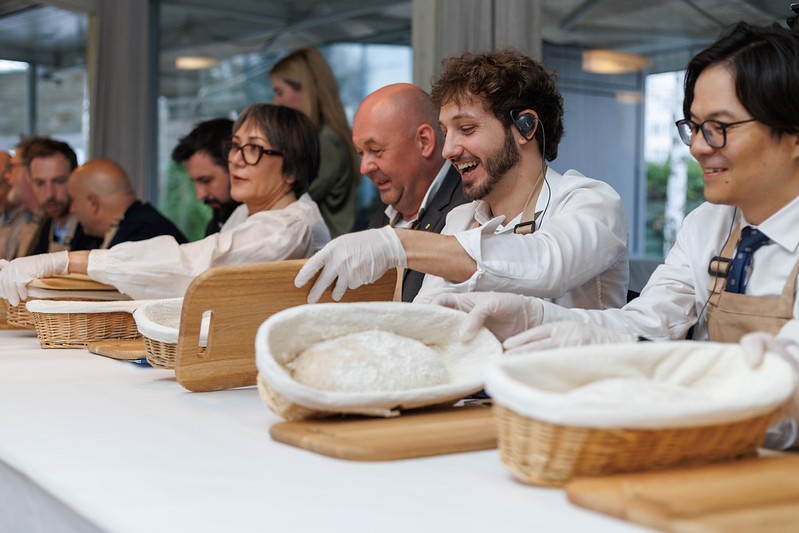
On April 3, the campaign launched at Tarilka gastro-café in Kyiv with a sourdough breadmaking masterclass—“Ave Bread”—led by chef Denys Komarenko, using flour from demined land in Sumy Oblast. Thirty-five guests, including ambassadors, diplomats, UN representatives, and Ukrainian influencers, gathered to bake paska, a traditional Ukrainian Easter bread. They used flour milled in Mykolaiv from wheat grown in Kherson and Mykolaiv oblasts, on land where sappers had cleared 1,800 hectares of mines to make the harvest possible. Farmer Oleksiy Rudenko, together with his nephews, had planted that wheat. A Mykolaiv producer, Golden Path, had milled it into flour—24,000 tons a year, sold across Ukraine and Europe. Every guest left with a loaf. At the launch, Deputy Minister of Economy Ihor Bezkharavainyi framed the initiative clearly: “Behind every product from a demined field is a story of resilience — of sappers who bring the land back to life step by step, and of farmers who return to work despite risks and ongoing shelling. These stories must be visible.”
This visibility matters because the scale of what Ukraine is dealing with is difficult to grasp. Before Russia’s full-scale invasion, Ukraine fed over 400 million people worldwide each year. Russian forces contaminated vast stretches of its farmland with landmines and unexploded ordnance. At the peak, up to 30% of Ukraine’s territory was potentially mined. Today that figure has been reduced to 23%—but 23% still means 133,300 square kilometers of potentially hazardous land, and two-thirds of it is farmland. One farmer featured in the project had over 280 anti-tank mines pulled from a single field. Today, sunflowers grow there.
The centerpiece dish of the original Soul of Soil menu makes this concrete. Chef Olga Martynovska’s zucchini caviar — what the project calls “the world’s most expensive dish” — required clearing over 6,000 hectares of mined land before a single vegetable could be planted. Martynovska, a Le Cordon Bleu-trained MasterChef winner from Mykolaiv Oblast, put it simply: “At what cost, what risks people take to grow grain so that I can then make a palianytsia bread. It’s impossible to put a price on this bread as its cost includes the price of life.”
That is the argument Soul of Soil makes every time someone orders from its menu. UNDP Resident Representative Auke Lootsma said at the April 2026 launch that no single country or institution can meet a challenge of this scale alone—“but together, through shared expertise, united commitment, and sustained solidarity, we are turning potentially contaminated fields back into places where communities can live, work, and thrive again.”
What makes the initiative worth celebrating is what it asks of ordinary people. Not everyone can fight, volunteer in a conflict zone, or lobby their government. But most people can order dinner . Soul of Soil makes that count. A plate of food, a story, and the money goes back into the clearing operations that let farmers return to their fields. It is the rare campaign that asks nothing extraordinary and gets something real in return.
Ukraine used to feed Somalia, Yemen, Sudan, and 54 other countries that depend on its grain. Every hectare that stays mined is a hectare that feeds no one. For now, the answer is a plate of zucchini caviar, a loaf of sourdough, a buckwheat cake—and the act of ordering one.