On Feb. 24, 2022, Mediazona, an independent Russian news outlet, began compiling a list. Every Russian soldier whose death could be verified by name — through obituaries, social media posts, cemetery records, memorial announcements — was logged. On Feb. 24, 2026, that list reached 200,000 confirmed names. It took four years. The list is not complete. It is not even close. Russia last disclosed its own battlefield losses in September 2022, when it reported that 5,937 soldiers had been killed. It has not updated that figure since. The Kremlin treats military casualties as a state secret, and when Russia’s ambassador to the UK was pressed last year on reports that losses had surpassed one million, he refused to provide an actual number. The gap between 5,937 and the independent estimates — which now range well above 200,000 dead — is not a statistical discrepancy. It is the result of deliberate policy. Moscow does not count its dead in public because doing so would make the cost of this war legible to its own citizens. This is the paradox of the war’s fourth anniversary. The numbers have reached a scale that defeats intuition, and yet the conflict has receded in global attention almost proportionally.
It is worth asking why those two trends have moved in opposite directions, and what it means for accountability when the world pays less attention to a war precisely as it becomes more deadly.
The Bloodiest War in Europe Since 1945
Russia launched its full-scale invasion on February 24, 2022, attacking from the north, east, and south simultaneously. The prevailing assumption, shared by Moscow and much of Western intelligence, was that the Ukrainian government would fall within days. That did not happen. Ukrainian forces repelled the initial assault on Kyiv, and President Zelenskyy, who was offered evacuation by the United States, chose to remain. By April, Russia had been forced to withdraw from the entire northern front, leaving behind evidence of mass killings of civilians in Bucha, Irpin, and Borodyanka.
In the months that followed, the United States and its NATO allies mobilized a substantial military aid programme — Javelin anti-tank missiles, HIMARS rocket systems, Patriot air defense batteries, main battle tanks, and eventually F-16 fighter jets. The EU alone has provided over €193 billion in combined financial, economic, and humanitarian support. This assistance, together with Ukraine’s own resistance, prevented Russia from achieving the rapid victory its leadership had anticipated, transforming what was planned as a short operation into a prolonged war of attrition that has now lasted four years. It is notable, though, that four years in, both the pace of Western aid and the strength of the language around it have softened considerably — a shift that is itself part of the story of where this war is headed.
Western support has been decisive in preventing Ukrainian collapse. Whether it has been equally decisive in defining a political end state remains less clear.
The resulting toll makes this, by every credible measure, the deadliest armed conflict in Europe since World War II. The Center for Strategic and International Studies estimated in Jan. 2026 that combined military casualties may be approaching two million. Russia has suffered an estimated 1.2 million casualties, including as many as 325,000 dead — the highest troop losses for any major power since 1945. Ukrainian losses stand between 500,000 and 600,000, with up to 140,000 killed. Zelenskyy said earlier this month that 55,000 Ukrainian soldiers had been killed. The UN has verified nearly 15,000 civilian deaths, a figure it considers a significant undercount, and civilian casualties rose 31 percent in 2025, making it the deadliest year of the war for non-combatants. Nearly 5.9 million Ukrainians are now registered as refugees abroad, with another 3.7 million displaced internally — meaning roughly a quarter of the pre-war population has been uprooted. When roughly a quarter of a country’s population has been displaced, it becomes difficult to make the case that this conflict is no longer consequential, even if it has receded from headlines.
The Cost of Each Kilometer
Russia now controls about 20 percent of Ukraine’s internationally recognized territory, having added roughly 29,000 square miles since the invasion — an area comparable in size to the state of Pennsylvania. However, the vast majority of that territory was seized in the first five weeks of the war. In nearly four years since, progress has been grinding. In 2025, Russia gained 0.8 percent of Ukraine’s territory, at an average rate of advance between 15 and 70 meters per day in its most prominent offensives — slower, as CSIS noted, than the rate of advance at the Battle of the Somme. The ISW calculated that in early 2025 Russia averaged roughly 99 casualties for every square kilometer captured. The Economist separately reported that Russia has lost up to one percent of its pre-war fighting-age male population to capture an additional 1.45 percent of Ukraine’s land. Each kilometer gained in 2025 cost approximately 120 soldiers. Defense spending has surged from $66 billion in 2021 to an estimated $149 billion in 2024. What these figures suggest is less a military strategy than a willingness to expend human lives, which complicates the common framing of Russia as negotiating from a position of strength.
These incremental gains are sustained, in large part, by a tactic that Russian soldiers themselves have come to call “meat storms” — wave-based infantry assaults in which small groups of soldiers are sent toward Ukrainian positions, followed by progressively larger groups, until the position is either taken or all attacking forces are dead. A former Russian soldier described the method in a BBC documentary released this week: send three men, then ten, then fifty. His regiment, he said, lost 200 soldiers in three days during a single such operation. The approach was pioneered by the Wagner Group using prison recruits during the siege of Bakhmut in 2022–2023 and has since been adopted widely across the Russian military. To sustain it, Russia recruits between 40,000 and 50,000 new soldiers each month, many of whom arrive at the front with minimal training and, in some cases, without adequate weapons. The daily casualty rate in 2025 was estimated at between 900 and 1,500 soldiers killed or wounded.
What happens to soldiers who refuse to participate in these assaults is increasingly well documented. An investigation by Verstka, an independent Russian outlet, confirmed over 150 cases of soldiers killed by their own commanders for declining orders. The methods reported include beatings, electrocution, confinement in pits, and execution at point-blank range — a practice referred to within the ranks as “zeroing.” In other cases, soldiers who refused were sent unarmed into suicide assaults as a form of punishment. The BBC documentary featured Ilya, a 35-year-old former special needs teacher from the Urals who was mobilized in 2024 alongside 78 others and is the sole survivor of the group. He was tortured for refusing to advance to the front and described watching a commander execute four men who had attempted to flee. Another soldier, Dima, recounted enduring 72 consecutive days of electric shock torture after refusing to order his men into an assault he believed to be suicidal. “I’m a criminal, and nobody cares,” he said. “My crime is just I don’t want to kill.” Russia’s military prosecutor’s office received nearly 29,000 complaints from soldiers and families in the first half of 2025 alone, more than 12,000 involving punishment by superiors. What emerges from these accounts is a pattern of systematic abuse directed at conscripts who are, in many cases, themselves victims of the state that started the war.
The question of whether the soldiers fighting this war understand or believe in its purpose is closely related. A study of Russian prisoners of war found that 55 percent were motivated primarily by financial incentives, while only 36 percent described themselves as ideologically driven. Men from Russia’s poorest and most remote regions — Buryatia, Tuva, Dagestan — are vastly overrepresented among the dead, and many soldiers deployed in the early months of the invasion were told they were participating in training exercises, not entering a war. Recruitment runs on enlistment bonuses and salaries several times the regional average. The contrast with the Ukrainian side, where soldiers overwhelmingly describe themselves as defending their homes and their country’s right to exist, clarifies why the war feels existential to one side and opaque to the other.
This asymmetry matters for how we evaluate proposed peace frameworks. One side is fighting for necessity; the other is relying on financial inducements to sustain a war of choice. Treating those motivations as equivalents does not hold up under scrutiny.
Marking Four Years
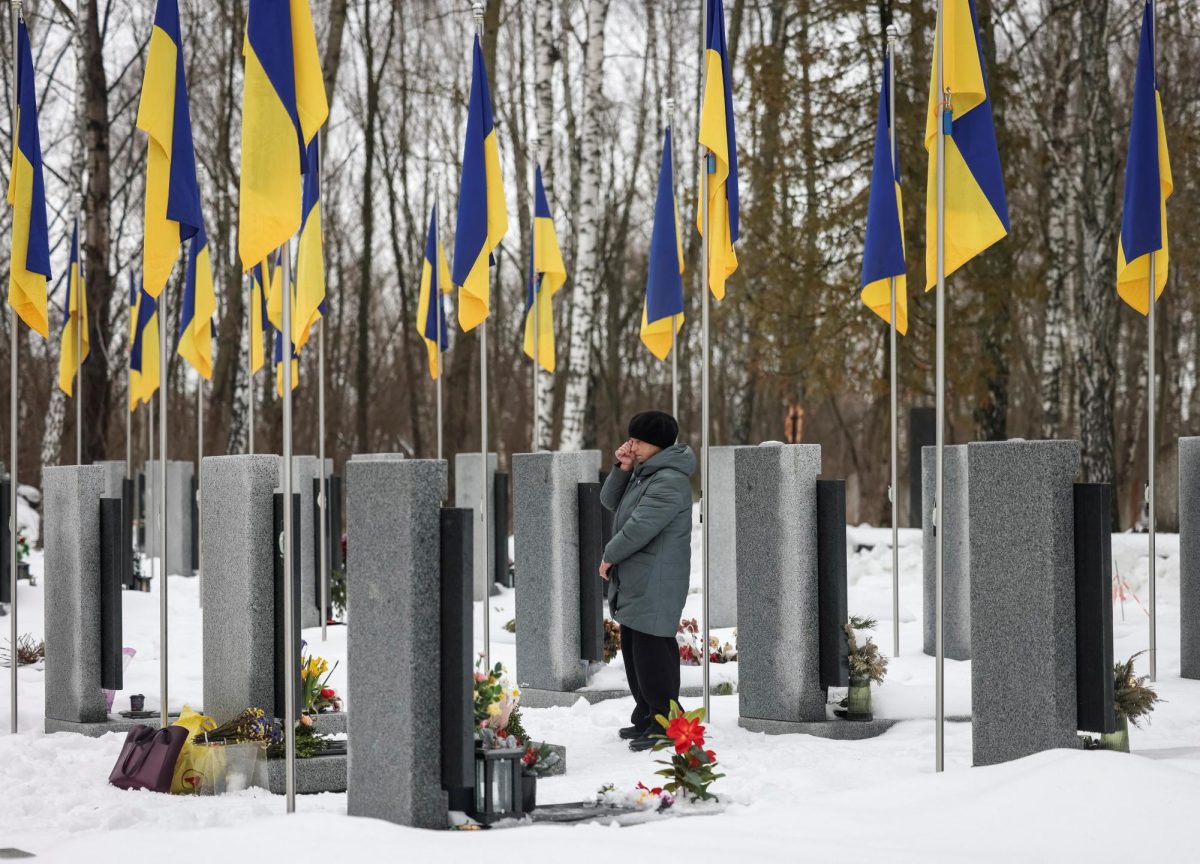
On Feb. 24, Ukraine marked the anniversary with memorial ceremonies across the country. In Kyiv, Zelenskyy joined European leaders for prayers at the Cathedral of Saint Sophia, where candles were lit for soldiers and civilians killed since 2022. In Bucha, relatives gathered at the Wall of Remembrance. Communities across the country, from Kharkiv to Odesa, held their own commemorations, each shaped by the particular losses that city or town has absorbed. At NATO headquarters in Brussels, Secretary General Rutte spoke alongside Ukraine’s representative to the alliance, and the UN General Assembly adopted a resolution by 107 votes to 12 reaffirming Ukraine’s sovereignty and calling for an immediate ceasefire.
Zelenskyy delivered a video address from the bunker where he lived during the first weeks of the invasion, a location he had not previously made public. He said that Putin had not broken Ukraine, had not won the war, and had not achieved his goals, and warned that Ukraine would not betray the sacrifices of its people in order to bring the conflict to a close on unfavorable terms. “We cannot, we must not, give it away, forget it, betray it,” he said. He invited Donald Trump to visit Kyiv. In a separate address to the European Parliament, he said that Ukraine never chose this war, did not start it, and did not provoke it, and he criticized nations that continue to purchase Russian oil for helping to fund the conflict.
European Council President António Costa and Commission President Ursula von der Leyen traveled to Kyiv for the ceremony and visited a damaged energy infrastructure site. The Coalition of the Willing — a grouping of 35 countries convened by France and the United Kingdom — met to reaffirm support. Britain announced its largest sanctions package since the early months of the war, targeting nearly 300 Russian entities. It was noted, however, that no head of a major Western government was physically present in Kyiv for the anniversary — a contrast with earlier years.
That absence suggests the political dynamics around supporting Ukraine have shifted. It also raises a less comfortable question about what was driving those dynamics in the first place. In 2022, the war dominated front pages and social media feeds, and public opinion in Western democracies strongly favored Ukraine. Visiting Kyiv was politically rewarding — it signaled leadership, resolve, and alignment with a cause voters cared about. Four years later, coverage has thinned, public attention has moved on, and the political incentive to be seen standing with Ukraine has weakened accordingly. The war has not changed in character, but what has changed is how much it costs a leader, politically, to ignore it. That pattern — support that rises and falls not with the severity of a crisis but with the volume of its media coverage — is worth examining on its own terms, because it suggests that the international response to this war was not always as principled as it was presented.
No End in Sight
In Moscow, there were no anniversary ceremonies. The Kremlin said the conflict had expanded into a broader confrontation with nations seeking to destroy Russia. The Kremlin dismissed Western casualty estimates, with spokesman Dmitry Peskov insisting that only figures from Russia’s own Defense Ministry should be considered reliable — a posture that raises its own questions about Russia’s willingness to engage with the basic facts of a war it started, let alone negotiate its resolution in good faith. The Trump administration, which halted direct American military aid to Ukraine after taking office in January 2025, has pursued a negotiated settlement through its envoys Steve Witkoff and Jared Kushner. Talks in Riyadh, Abu Dhabi, and Geneva have produced no breakthrough. Russia continues to demand that Ukraine withdraw from parts of the Donbas it still holds; Ukraine refuses. Zelenskyy has said that any agreement would require ratification by the Ukrainian people through a referendum, and polling shows that a majority of Ukrainians reject ceding territory. Few analysts believe a settlement is imminent. Putin’s strategy appears built on patience — the assumption that Western unity will fray before Russian capacity does. The underlying premise seems to be that democracies tire faster than authoritarian systems, especially when the costs are gradual rather than immediate. Whether that wager pays off will depend on factors he does not fully control: European resolve, American politics, Ukraine’s military endurance and the cost Russia itself can sustain. What that patience really amounts to is a bet that Western democracies will lose interest in the war before Russia runs out of people willing to enlist for money. Four years in, it is not clear that bet is wrong.
There is a temptation, on anniversaries like this, to insist that the meaning of the war is obvious and that policy should follow directly from it. In many respects the moral picture is clear: Russia launched an unprovoked invasion of a sovereign state, and Bucha, Mariupol, and the systematic destruction of Ukraine’s energy grid — every power plant in the country has been hit — are documented facts, not matters of interpretation. But moral clarity does not produce policy clarity, and the gap between them defines the war as it enters its fifth year. It is possible to agree that Ukraine has the right to defend itself and still disagree about what the world owes it in practice, what compromises are tolerable, and what peace can be reached that does not simply reward conquest. But it is important to be honest about what compromise would actually mean in practice: it would mean telling displaced Ukrainians that the homes they left are not coming back, and telling the families who gathered at the Bucha wall that the country their relatives died defending will be smaller than the one they fought for. That may ultimately be the outcome, but it should be acknowledged for what it is rather than framed as a reasonable middle ground.
On the morning of Feb. 24, Russian strikes hit Zaporizhzhia. In the Donbas, soldiers are fighting over ground most people have never heard of. In Bucha, families stand before a wall of names. In Moscow, there is silence. Mediazona is still adding to its list.