In early 2026, Russia remains the central disruptor of European security. Russian missile and drone strikes continue to target Ukraine’s energy infrastructure even as diplomatic talks proceed. At the same time, the New START treaty, the last remaining U.S.-Russia strategic arms control agreement, is set to expire, removing the final legally binding cap on the world’s two largest nuclear arsenals.
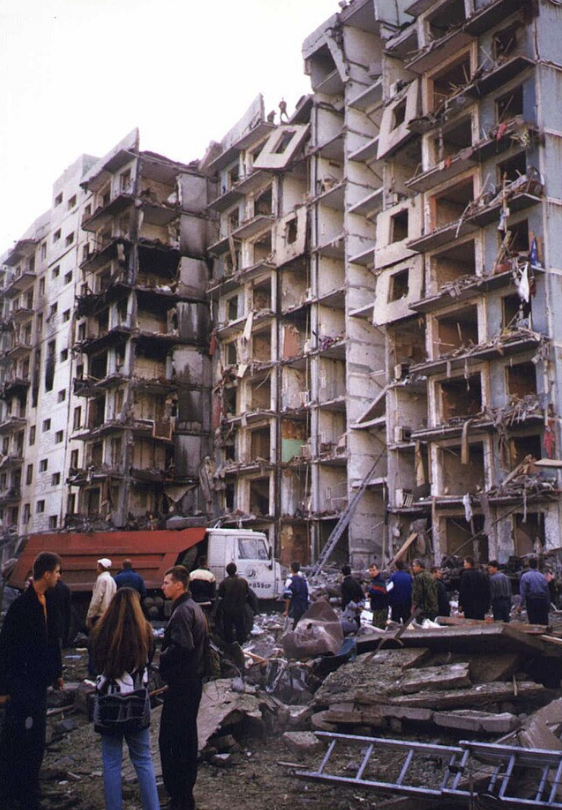
To understand why the Kremlin appears willing to sustain a costly war, absorb long-term sanctions, and tolerate escalating nuclear risk, it is worth revisiting a formative moment in Vladimir Putin’s rise to power. Putin had been appointed prime minister in August 1999, only weeks before a series of apartment bombings killed hundreds of civilians across Russia in September. More than two decades later, the origins of those attacks remain contested.
That unresolved history still matters. The political logic forged in 1999 did not end with Putin’s election. It created a governing model that continues to shape Russia’s domestic authority and foreign policy behavior today.
By the late 1990s, Russia’s post-Soviet transition was marked by economic instability, corruption scandals, and a looming succession crisis. President Boris Yeltsin’s health and legitimacy were deteriorating, and the Kremlin sought a successor who could protect elite interests while restoring order. Putin, a former KGB officer who had moved through the presidential administration and later led the Federal Security Service, was appointed prime minister in August 1999. Within weeks, the apartment bombings transformed the political environment. Public fear spread rapidly. Pressure mounted for decisive state action.
Putin responded by framing the attacks as terrorism linked to Chechnya and launching the second Chechen war. His approval ratings rose sharply. Military force became associated with competence and control. The security services emerged as the central pillar of the state.
The political consequences of the bombings did not depend on definitive attribution. They depended on the crisis they produced.
That crisis was never fully resolved. The Ryazan incident, in which suspicious materials were discovered in an apartment basement and later described by authorities as part of a security exercise, ensured that doubts surrounding the bombings endured. Investigations were limited. Independent inquiries encountered obstruction. Key questions remained unanswered. This ambiguity proved politically useful. It demonstrated that uncertainty itself could reinforce authority. Political competition could be reframed as instability. Independent media could be portrayed as a security risk. Emergency measures could be normalized.
The result was a system that fused domestic legitimacy with threat management. That fusion continues to inform Russia’s external behavior. In 2026, the same logic is visible in Russia’s confrontation with Ukraine and the West. Military pressure persists even alongside negotiations. Sanctions are framed as confirmation of hostile encirclement rather than incentives for policy change. Nuclear risk becomes a tool of signaling rather than restraint.
Western policy often assumes that sustained pressure will eventually compel adjustment. Russia’s response suggests a different dynamic. Sanctions have imposed real costs, but they have not altered Moscow’s strategic objectives. Instead, they have reinforced a worldview in which endurance and resistance are central to state survival. This does not mean pressure is ineffective. It means pressure must be paired with enforcement and strategic clarity. Sanctions implementation, financial oversight, and rapid attribution of disinformation matter as much as formal measures. These tools constrain capacity rather than reinforcing narratives of siege.
It is fair to question whether revisiting the 1999 bombings yields new factual insight. The evidentiary record is incomplete, and definitive attribution is unlikely. The significance of the episode lies elsewhere: in how unresolved crises were used to consolidate authority and normalize emergency politics. Putin’s system does not depend on resolution. It converts ambiguity into political authority, a dynamic that helps explain how the state sustains itself under prolonged pressure.
The events of September 1999 did more than accelerate a political succession. They informed a governing logic in which domestic legitimacy and foreign policy became inseparable. For students, the relevance is not limited to Russia or foreign policy. The case illustrates how political authority can be built and maintained through uncertainty, and how unresolved events can become durable features of power rather than historical footnotes.