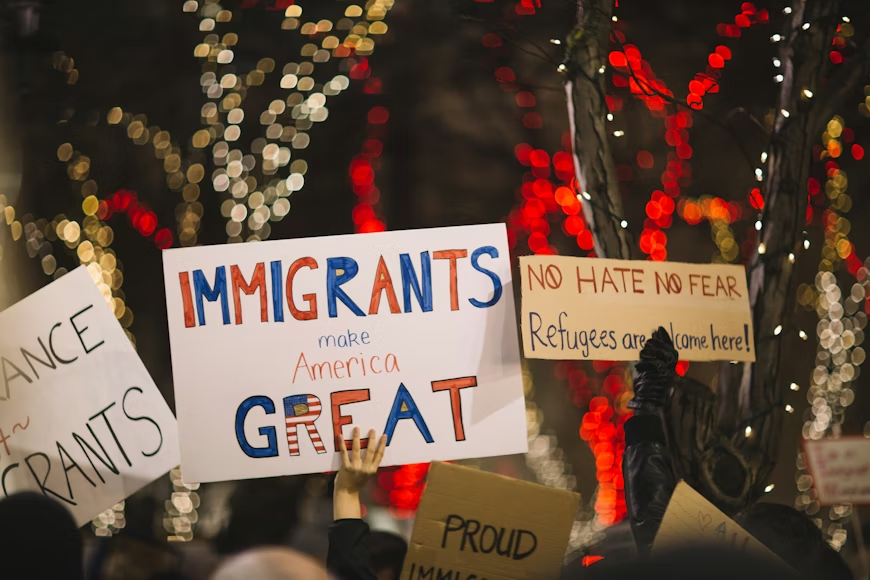
On Feb. 1, 2026, the annual Grammy Awards show took place. Despite its annual occurrence, this year was different: celebrities stood up to U.S. Immigration and Customs Enforcement (ICE). Celebrities like Hailey and Justin Bieber wore “ICE Out” pins, and most notably, Bad Bunny spoke out against ICE after winning “Album of the Year” during his time on the Grammy Awards stage. The artist spoke on stage saying, “Before I say thanks to God, I’m going to say: ICE out. We’re not savage, we’re not animals, we’re not aliens. We are humans, and we are Americans.” Press Secretary Karoline Leavitt responded two days later, claiming, “It is ironic and frankly sad to see celebrities who live in gated communities with private security, with millions of dollars to spend protecting themselves, trying to demonize law enforcement.” She dismissed the protests rippling around the country and irresponsibly framed ICE simply as law enforcement doing its job.
But reducing ICE to just another branch of policing ignores the agency’s history, the controversy surrounding its practices, and the fear it has created in many immigrant communities. To understand why artists felt compelled to speak out, we have to look beyond the red carpet and examine what ICE is, how it operates, and why it is more than just routine law enforcement.
Before, ICE was the Immigration and Naturalization Service (INS). After the September 11 attacks, the U.S. government reorganized immigration agencies under the new Department of Homeland Security, which broke the INS into different parts. ICE was created in 2003 as part of this restructuring, linking immigration enforcement to national security concerns rather than treating it solely as routine policing. ICE operates as a subagency under the Department of Homeland Security, alongside three other internal oversight offices (that have largely been gutted under the current administration). The head of the Department of Homeland Security is appointed by the executive branch; therefore, ICE operates differently depending on the administration in office. ICE’s mission is claimed to be as follows: “Protect America through criminal investigations and enforcing immigration laws to preserve national security and public safety.”
In practice, however, the agency has expanded rapidly while reducing safeguards meant to ensure responsible enforcement. An unnamed DHS official told NBC News that ICE shortened officer training from thirteen weeks to eight, and then again to just six weeks, even as the agency dramatically expanded hiring. At the start of 2026, DHS announced a 120 percent increase in personnel, adding approximately 12,000 officers and agents nationwide. Rapid expansion paired with shortened training raises serious questions about the abilities of said “law enforcement” to make decisions about families and communities.
This is where the key insight emerges. Immigration enforcement isn’t just government policing; it’s also an industry. Immigration enforcement in the United States today relies heavily on private corporations that profit from detention and deportation. ICE contracts with private prison companies like CoreCivic and GEO Group to build, run, and expand immigration detention facilities, and these companies are in a position to increase their roles, and their profits rise with expanding detention spending.
As of early 2025, nearly 90 percent of people in ICE custody were held in privately operated facilities, illustrating how much of the immigration detention system is run for profit rather than public oversight. Private companies also provide technologies, such as data analysis and surveillance tools, that ICE uses to track and monitor migrants, including platforms that integrate social media, licensing, and location data into unified enforcement files. Some Fortune 500 companies that have contracts with ICE may surprise you, with the biggest names including: Amazon, AT&T, FedEx, UPS, Motorola, Comcast, and Eco Lab. These are just a few out of the masses. Because ICE is revenue for these corporations, their financial incentives are tied to maximizing detention and deportation, not protecting human rights, and this profit motive shapes how enforcement operates in practice.
What began in Minneapolis and is causing widespread protests across the country is the devastating human cost of this system. Families who have built lives in the United States have been torn apart aggressively by enforcement practices, with a large focus on children. Five-year-old Liam Conejo Ramos has received mass attention around the country. The New York Times writes, “One of the many unsettling images to emerge from the recent ICE surge in Minneapolis was that of 5-year-old Liam Conejo Ramos, in his blue bunny hat, standing in the January cold with the hand of a federal officer gripping his Spider-Man backpack.” The KFF stated that “some parents, particularly those who are undocumented or who have an undocumented family member, said they would only leave the house when necessary, such as for work; limit driving; or no longer participate in recreational activities, leading to children spending many hours inside.” In addition, “parents and pediatricians reported a broad array of impacts of increased fears among children, including behavioral changes, such as problems sleeping and eating; psychosomatic symptoms, such as headaches and stomachaches; and mental health issues, such as depression and anxiety.”
With its deportation quotas, this administration’s dehumanizing rhetoric, and extrajudicial pronouncements that agents have “absolute immunity,” ICE has become more than just “law enforcement.”
The Grammys protest wasn’t just celebrities making a political statement. It reflected what many communities have been experiencing for years: an enforcement system shaped by politics, profit, and policies that often leave families living in fear. Calling ICE simply law enforcement ignores the history, the industry built around detention, and the real consequences for people’s lives. Until immigration enforcement stops producing those outcomes, people will keep speaking out, whether on stage or in the streets.