PinkPantheress’s “Stateside” is stuck in my head.
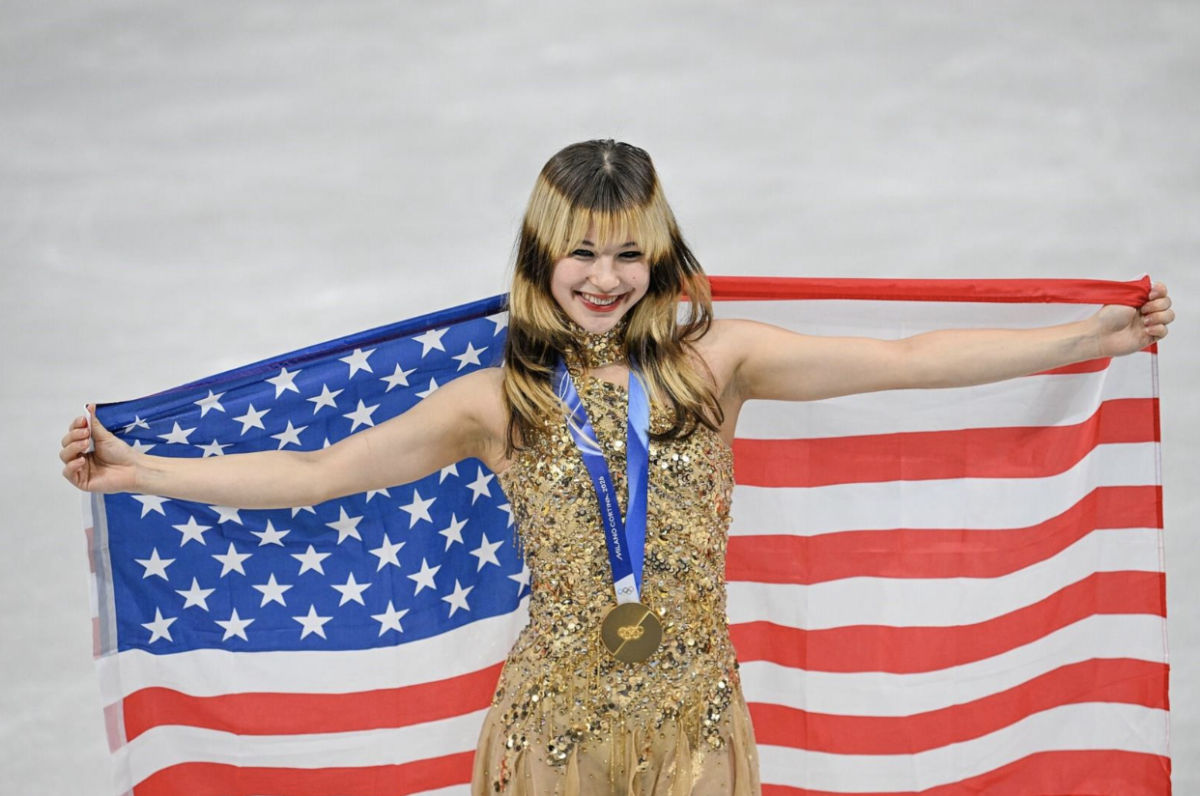
Alysa Liu’s gala skate will do that to you. Liu dazzled fans worldwide with her magnetic joy on the ice, somehow creating a moment more iconic than her gold medal victory just two days prior. After working her entire life to reach the pinnacle of her sport, breaking a 20-year gold medal drought in the process, Liu proved just how much she loved her craft. As I watched her dance across the ice, I found myself feeling something beyond admiration for an athlete, beyond anything as simple as national pride, and beyond anything I could truly understand in the moment. Only now, later, do I find myself asking: what exactly was I feeling? What does it say about what patriotism actually is?
The fact that it took Alysa Liu to make me ask says more about me than about her. For most of my life, patriotism felt like a word that belonged to someone else. Not because I did not love my country, but because the people that claimed their love the loudest often weaponized it: to narrow the definition of America, to exclude those who did not look like their idea of an “American,” and to demand conformity to an arbitrary, nostalgic “ideal” rather than to inspire love. I have always loved my country, but I have done so quietly as to avoid being labeled as someone who I am definitively not. Then, Alysa Liu skated across the screen, and I no longer felt any reason to keep my national pride silent. It was the kind of feeling you do not trust at first because of how long you’ve spent keeping it at a distance. But what exactly is patriotism?
The word gets claimed so often and by so many that it risks meaning nothing at all. Politicians wrap themselves in it and weaponize it against members of the other party. It gets pinned to lapels and printed on bumper stickers until it begins to seem more like a tribal symbol than a genuine emotion. In our current climate, the term is incredibly vague. Yet, watching Liu’s performance, I felt something shockingly specific—something far more resonant than the countless “Don’t Tread on Me” flags planted on fenders.
Patriotism is not contingent on the nation’s current condition, nor is it a worship of the past, nor is it the blind approval of the present. It is closer to what a good relationship looks like: clear-eyed, exacting, and unconditionally committed. Patriotism is when you love the country so much that you want it to become the best version of itself, when you love it enough to hold it accountable.
The right’s version of patriotism gets closer than it is given credit for—although it may be retrospective and glorifying, there is genuine love underneath it. Republicans are significantly more outwardly patriotic than Democrats. A recent Gallup Poll found that 92% of Republicans call themselves “extremely or very proud” to be American compared to only 36% of Democrats.
But the right’s patriotism too often mistakes symbols for substance—the flag for the republic, our history as mythology, the Constitution as scripture rather than a living document. It demands that you venerate a romanticized daydream of what America was, rather than work towards what it could be. The result, at the most extreme end, is January 6: rioters carrying American flags into the Capitol as weapons against the very institutions those flags are meant to represent. The result is the denial of the fair-and-free 2020 election because it does not fit the candidate they idolize. That is a love of a version of our country that has never existed.
The left’s failure is less dramatic, but more durable. The same Gallup Poll also revealed that Democratic pride fluctuates nearly perfectly with who is occupying the White House—rising and falling with political satisfaction rather than a stable, ongoing love of country. That poll might as well have been written about me—my pride has tracked the political moment more than I would like to admit. The Democrats mistake patriotism for approval, and I know this because I am guilty of it. Patriotism and political satisfaction are distinct from one another, and confusing them has rendered the left’s politics emotionally untethered.
This withdrawal turns the party away from the very belief that makes reform possible. The left’s retreat from national belief does not seem radical—it reads as sophistication, as level-headed realism about a country with substantial flaws. This framing has infrastructure: when the most influential media outlets treat national pride as naivety, that sensibility becomes the default posture of their consumers. It spreads through institutions, through culture, and through the way young people are taught to think about the country. That is more deeply embedded, and significantly harder to reverse. Effectively, they abandon their national love during times in which they need it most. You cannot create change in a country that you have stopped believing in.
The civil rights movement succeeded because it was grounded in a genuine love for the country and its founding ideals. It was driven not just by an opposition to what America was, not just by anger toward injustice, but by fierce, demanding love for what America was promised to be. That love gave it moral authority. It gave it the strength to continue fighting through decades of adversity. It gave it the language necessary to hold the country accountable, bettering it for its people and its posterity. Martin Luther King Jr. pushed back against the American status quo, but he did so by echoing the principles the nation was founded upon, and his love for the nation still resonates today. What King understood, and what Liu embodies, is that the most radical thing you can do in a country that questions your belonging is to love it anyway—and then do the work required of you.
There is something genuinely unfair about this. The burden of loving a country falls heaviest on those who have the most reason not to. Liu did not have to skate for America. King did not have to frame his demands in the nation’s own founding language. They chose to, and that deliberate choice is exactly what gave their love its force.
Alysa Liu did not wait to be welcomed. She came back from retirement, worked for two years, broke a 20-year drought, and then held up her medals saying “these are for y’all.” After all that work, she did not claim her trophies for herself. She shared them with an American people that does not always claim people who look like her. Two days later, she skated to her favorite song with nothing at stake but absolute joy. Her work was done. Her love for skating, and for America, was visible. She was not performing patriotism—she was practicing it.
I understood none of this until recently. For years, like many others, I kept my pride quiet. I waited, like so many on the left, for the country to be worthy before I loved it. I had confused patriotism with approval, love with satisfaction, and in doing so lost the emotional foundation that makes my home worth fighting for.
I now know what I was feeling while watching her. It was not a pride in government, nor was it a reverence for the flag, nor was it a nostalgia for the nation’s past. It was the feeling of watching someone love America without waiting, without needing the country to earn it first. It was the sudden recognition that I could too.
Patriotism is Alysa Liu skating for her country on her own terms, under the lights, with PinkPantheress in the background.